
Fuel Additives: What Works, What's Banned, and Where the Money Is
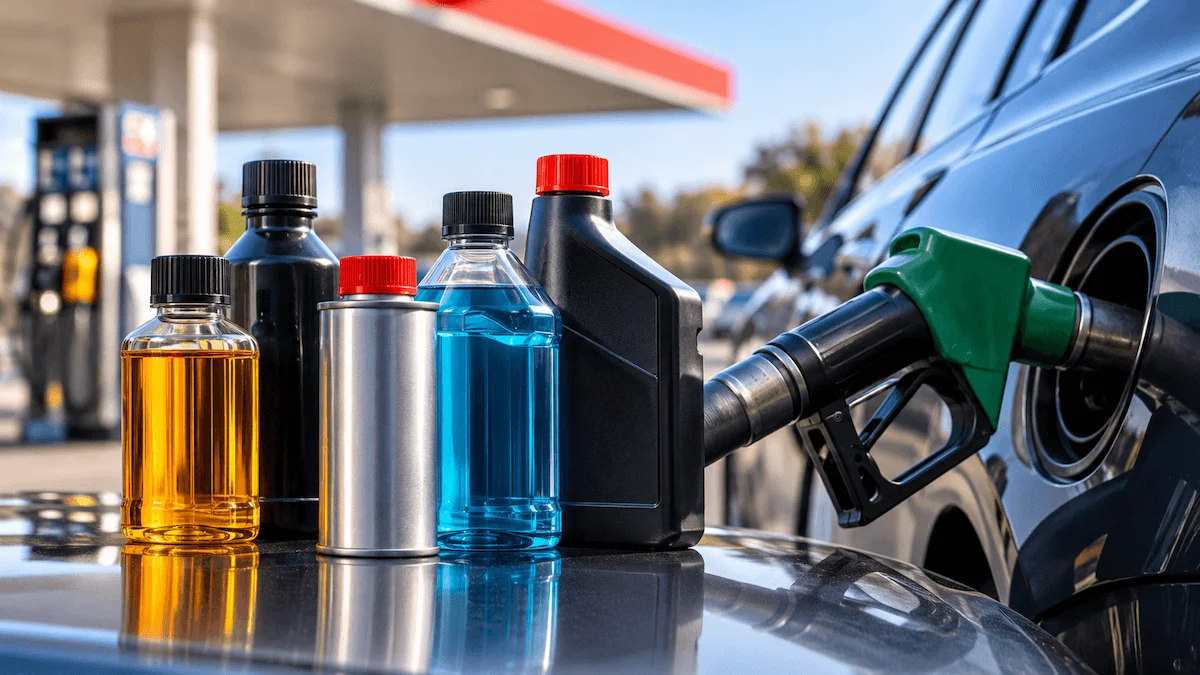
No marketing, no myths: why a "+5 octane" bottle physically cannot work, which additives are outright prohibited by EAEU technical regulations, and what actually protects your engine when fuel quality is inconsistent.
Start with the arithmetic
A typical additive bottle holds 300 ml and treats a full tank — say 50 litres. That's 0.6% of the fuel by volume.
Now compare that with working dosages. For MTBE to raise the octane rating noticeably, it's blended at 5–15%; at 10% the gain is roughly 2–6 points. Toluene at the same 10% adds about 7–10 points.
A working dose is therefore about 15 times larger than what's in the bottle. At 0.6%, octane simply won't move. That's not a question of brand — it's a question of proportion.
There is one exception: monomethylaniline (MMA). It genuinely works at around 1%. Which is precisely why regulations restrict it.
What's actually prohibited — not merely "debated"
Fuel sold across EAEU countries falls under technical regulation TR CU 013/2011. Two provisions matter to anyone buying additives:
Clause 4.2: additives containing manganese, lead or iron are not permitted in motor gasoline.
For classes K2–K5, iron and manganese content must read "absent."
MMA by volume: no more than 1.0% for K3 and K4; for K5, absent.
The practical consequence: popular octane boosters based on ferrocene are iron-containing additives. They do raise octane at a small dose, but:
the resulting fuel doesn't meet the iron requirement;
they leave the telltale rust-coloured deposit on spark plugs and kill them quickly;
on a modern car they go on to destroy the catalytic converter and oxygen sensors.
A catalytic converter costs more than a full year of fuel savings.
What does work
One category has a demonstrated effect: fuel-system cleaners based on PEA (polyetheramines). Bench tests involving engine teardown show that quality PEA formulations remove a meaningful share of deposits from injectors and valves.
With the caveats that keep this honest:
the effect is moderate — prevention, not repair;
it works with regular use, not a single "miracle flush";
it doesn't undo wear: rings, bearings and cylinders stay as they are;
it doesn't fix a fault — if the engine misfires, the cause is more often plugs, coils, sensors or mechanical.
Read the composition on the label, not the design of the bottle.
Why the question is different here
Two facts change the picture in Kyrgyzstan.
Fuel arrives from several sources. Russian refineries remain the main supplier, but 2026 also brought the first rail shipments of AI-92 from China. Fuel traders themselves warned publicly that quality will now vary, because supply comes from different countries.
Traders already dose octane boosters to bring fuel up to grade. So when you add a bottle, you're layering chemistry on top of chemistry whose composition you don't know.
In summer 2026, after price regulation on AI-92 was lifted, drivers circulated complaints on social media about AI-95 and AI-100 quality — clogged fuel systems and failed spark plugs. Those complaints were never officially confirmed, but the wariness is understandable.
A note on high-mileage engines
Here's the counterintuitive part: if an engine has never been cleaned, an aggressive flush can make things worse. Loosened deposits travel into the catalytic converter or block the injectors. Hence the classic "I added a flush and it got worse."
On an older engine, start with a mild formulation and the minimum dose.
What actually protects an engine
Boring, but effective:
One filling station you trust. When supply is inconsistent, consistency beats branding.
Fuel filter on schedule. Dirty fuel kills the pump and injectors faster than any "missing additive."
The grade in your manual. Running 95 in an engine designed for 92 buys you nothing.
Keep the receipt. If the car starts misfiring after a fill-up, the receipt and station address are your only grounds for a claim.
If you're buying a used car
The consequences of bad fuel — and of "treating" it with additives — show up in the service history: spark plugs replaced off-schedule, catalytic converter, injectors. On cars imported from Korea and the USA, this is visible in inspection records.
A VIN report shows mileage, accident history and inspection data — cheaper than discovering a dead catalytic converter after the deal closes.