
Fuel in Bishkek 2026: AI-95 Shortage, Rising Prices, and What Car Buyers Should Choose
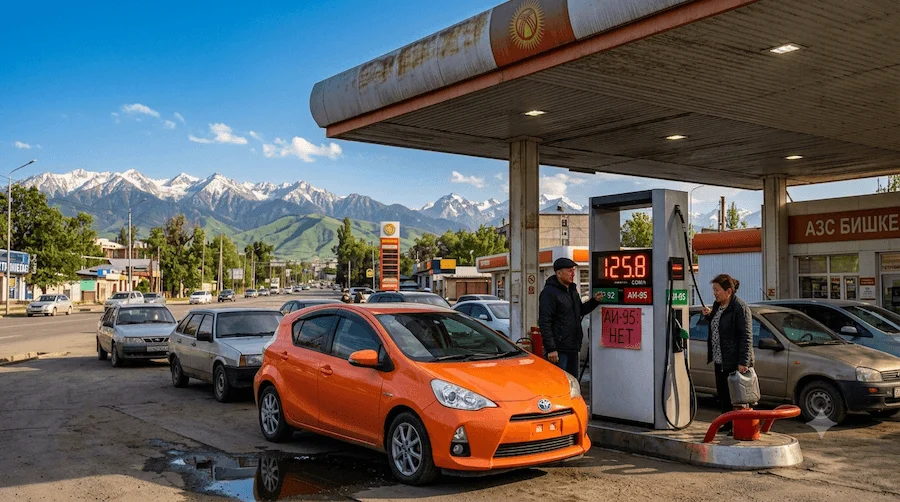
A breakdown of the current fuel situation in Bishkek: why AI-95 disappeared, what gasoline actually costs at the pump, what the government is doing, and how it's reshaping Kyrgyzstan's car market.
What's Happening Right Now
As of mid-July 2026, gas stations in Bishkek continue to face a shortage of high-octane gasoline. AI-95 keeps appearing and disappearing — at some stations it's simply gone. High-octane AI-100 remains available only at select stations (such as Bishkek Petroleum). Meanwhile, regular AI-92 and diesel are available almost everywhere. Some stations are temporarily closed.
The biggest change is prices. In early July, authorities removed AI-95 from price controls (holding a fixed price on a product that had vanished from stations was impossible), and where AI-95 is still sold, it has become noticeably more expensive. Prices keep creeping up — within just a few days several stations raised them again.
What Fuel Costs
Prices at Bishkek gas stations as of July 16, 2026:
AI-92 — roughly 79–83 som per liter, available at most stations
AI-95 — 85 to 98 som per liter where available; availability changes day to day, missing at some stations
AI-100 — available at select stations (such as Bishkek Petroleum), but not everywhere
Diesel — 95–97 som per liter
Autogas — 44–47 som per liter
For comparison: in January 2026, AI-92 cost about 74 som and diesel about 79. To track which fuel is available where, drivers use the grassroots service benzbarby.com — a real-time station map populated by drivers themselves.
Why the Shortage Happened
Kyrgyzstan imports more than 90% of its petroleum products, and nearly all of it comes from Russia. Domestic refining covers only about 5% of demand. In spring and summer 2026, Russia temporarily restricted gasoline and diesel exports to stabilize its own market, and supplies to Kyrgyzstan dropped — first and foremost for high-octane grades, which are barely produced within the country.
What the Government Is Doing
Price regulation — from May 25, 2026, retail price caps and importer subsidies were introduced. AI-95 was later removed from regulation after it disappeared from stations.
Export ban — from July 14, an indefinite ban on exporting fuel out of the country until the domestic market is fully supplied.
New suppliers — negotiations are underway with six countries (Kazakhstan, Belarus, China, Uzbekistan, Azerbaijan, Turkmenistan); some deals have already been reached.
How This Is Reshaping the Car Market
Fuel instability has sharply turned the car market toward economical vehicles, and it shows in the statistics.
The number of registered electric vehicles in the country grew from 3,100 at the end of 2024 to nearly 20,700 in 2026. The 15,000-unit duty-free import quota was 93% used by the end of June — demand is enormous. BYD, Chery, and Tesla are entering the market at scale, and Bishkek already has around 40–50 public charging stations.
Overall imports are booming too: in January–February 2026 alone, about 25,900 passenger cars were imported — 39% more than a year earlier. The leaders: China, South Korea, and the USA.
What to Buy in These Conditions
Worth considering:
Hybrids — Toyota Camry Hybrid, Hyundai Sonata Hybrid, Kia Niro. Consumption of 4–6 liters instead of 11–13 for a gasoline equivalent.
Compact cars — Hyundai Accent, Kia Rio with 1.4–1.6 liter engines.
Electric vehicles — if you drive in the city and have somewhere to charge.
Be more cautious with:
Large SUVs with gasoline engines over 4 liters — 15+ liters per 100 km in the city.
Cars that require only AI-95 — that's exactly the grade in short supply right now and not available at every station.
What Matters When Buying
High demand in the car market always means a higher risk of ending up with a problem vehicle — one with a rolled-back odometer or hidden accident damage. This is especially true for the flow of imports from Korea and the US, and for hybrids and EVs, also the battery condition.
Before buying any used car, check its history by VIN. A report costs a few dollars but protects you from losing thousands. When every fill-up hits your wallet, buying a problem car is a double blow — one that's easy to avoid.
Bottom Line
The 2026 fuel shortage exposed Kyrgyzstan's core vulnerability — its near-total dependence on imports from a single source. The market responded in its own way, pivoting toward economical and electric cars. For a car owner, the takeaways are simple: fuel consumption matters more than ever, hybrids and EVs have become mainstream, and checking a vehicle's history by VIN before buying is now a mandatory step.