
How to Buy a Car on Encar (and What to Check Before You Pay)
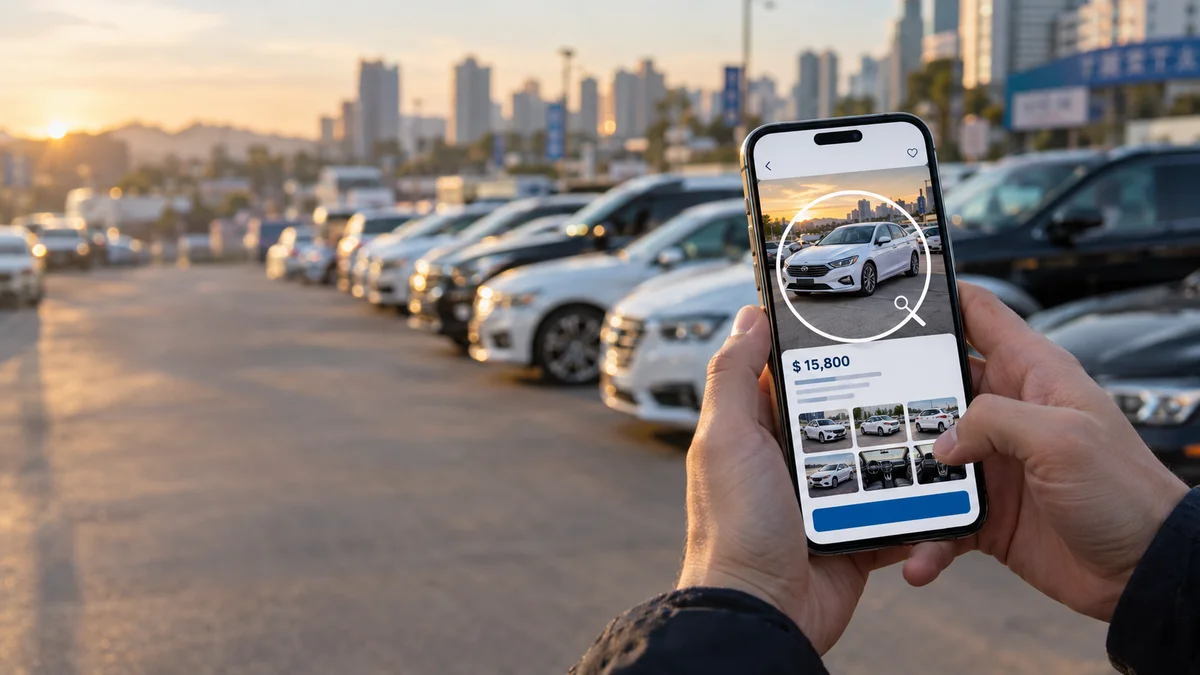
Encar is where most Korean used-car exports start. Here's how to read a listing, find the VIN, spot bait prices and ex-taxis, and pay safely, so the car that arrives is the car you saw online.
If you're buying a used car from South Korea, the car you end up with was very likely listed on Encar first. It's the country's largest used-car marketplace, and most export brokers find their cars there too.
Encar listings are detailed. That's the good news. The bad news is that they're in Korean, the most important labels don't mean what foreigners assume, and the listing is written by the seller. This guide shows you how to read an Encar listing, what to verify independently, and how to pay without getting burned.
Quick Answer: How to Buy a Car on Encar Safely
Find the car on Encar and convert the price correctly (prices are in units of 10,000 won).
Get the VIN from the listing's inspection record, or ask the dealer for it.
Run the VIN through an independent history check before you contact a broker or pay anything.
Compare the mileage, accident record and body diagram with what the listing claims.
Buy through a registered exporter. Pay a deposit of 10–30% and the balance only after the car is loaded on the ship.
What Encar Is
Encar (encar.com) is South Korea's biggest online used-car marketplace. Most listings come from licensed dealers, with a smaller share from private sellers. Because every used car sold by a dealer in Korea must pass a mandatory pre-sale inspection, a typical Encar listing comes with far more information than a listing in most other countries: photos, the official inspection record, and often a summary of the car's insurance history.
Foreign buyers rarely buy from Encar directly. Buying in Korea requires local identity verification, payment and export paperwork, so in practice you pick a car on Encar and an export broker or dealer buys and ships it for you. That makes it even more important to check the car yourself: the broker earns a commission on the sale, not on your satisfaction.
How to Read the Price
This trips up almost every first-time buyer. Encar prices are shown in 만원 (man-won), which is 10,000 Korean won.
2,350만원 = 23,500,000 won
At about 1,340 won per US dollar (October 2026), that's roughly $17,500. The rate moves, so check the current one before you budget.
Two more things about the price:
The listed price is not your total cost. Add the broker's fee, inland transport to the port, shipping, customs in your country and registration. See our guides to importing to CIS countries and importing to the Middle East.
Exports are zero-rated for Korean VAT. If someone quotes you the Encar price and then asks for 10% "VAT" on top, that's a scam. Our guide to Korean VAT schemes covers this and eleven other tricks.
The Parts of an Encar Listing That Matter
The inspection record (성능점검기록부)
This is the official pre-sale inspection report from a licensed inspection station. It's the most valuable part of the listing: it records the mileage, a body diagram showing replaced and repaired panels, and the condition of dozens of components. We explain it line by line in how to read a Korean inspection report.
The "no accident" label (무사고)
Here's the trap. In Korea, a car counts as an "accident car" only if its structural frame was repaired or replaced. Replacing bolt-on panels such as a hood, fender, door or trunk lid is a "simple exchange" and does not make the car an accident car.
In our analysis of 1.5 million Korean inspection reports, only 14.4% of cars had an accident record, but about 4 in 10 had at least one body panel replaced. A listing marked 무사고 can be perfectly honest and still describe a car that was hit and rebuilt. Always look at the body diagram, not the label. The full numbers are in our accident statistics study.
The insurance history summary
Listings often include a summary from Korea's insurance records: the number of claims, the amounts paid, owner changes, and whether the car was ever registered for rental or commercial use. It's useful, but it only contains what went through an insurer. Repairs paid in cash never appear there, which is another reason the body diagram matters more.
Encar's own diagnosis badge
Some listings carry an Encar diagnosis badge (엔카진단). It appears only on cars that Encar's own staff have inspected and verified as accident-free, on top of the mandatory inspection, so most listings won't have it. It's a good sign, but it doesn't replace an independent check of the car's full history.
How to Find the VIN on Encar
The 17-character VIN (차대번호) usually appears on the inspection record attached to the listing. Dealer listings almost always include that record. Private-seller listings sometimes don't. The listing itself mostly shows the plate number (차량번호), which you can't use to look up a car's history abroad.
If the VIN isn't visible, ask the dealer or your broker for it before anything else. A seller who won't share the VIN is the clearest red flag in the whole process. There's no legitimate reason to hide it.
Once you have it, check that it matches the car: the first characters identify the maker (KMH, KM8 or 5NP for Hyundai; KNA or KND for Kia). If you're unsure what the code means, our Hyundai and Kia VIN guide decodes it.
Check the Car Before You Contact a Broker
Most buyers pick a car, agree a deal with a broker, and only then check the history, when they're already emotionally committed. Reverse the order. Run the VIN first, then decide whether the car is worth a conversation.
An independent report lets you check the things the listing can't prove on its own:
Mileage across several inspections. A single number can be wrong. A chain of readings that only ever goes up is much harder to fake.
Which panels were replaced or repaired, with bolt-on and structural parts shown separately.
Photos from the inspection station, taken before any cosmetic preparation for sale.
The accident record, so you can compare it with the 무사고 label.
Here's what that looks like on a real report for a Hyundai Avante, one of the most common cars on Encar.
Red Flags in an Encar Listing
Mileage far below normal for the year
Korean cars cover roughly 10,000–12,000 km a year. Compare the listing with the median for its model year:
Model year | Median mileage |
|---|---|
2016 | ~94,000 km |
2018 | ~70,000 km |
2020 | ~53,000 km |
2022 | ~39,000 km |
Low mileage can be genuine, but a 2018 car showing 30,000 km deserves a close look at its inspection history. More years are in our mileage-by-year study.
A price well below similar cars
Korea's used-car market has a long-standing problem with bait listings: a car advertised below market to generate calls, which then turns out to be "just sold" or worse than described. If one car is priced far below identical cars of the same year and mileage, assume there's a reason until the history proves otherwise.
LPG versions of popular sedans
For years, LPG cars in Korea were sold mainly for taxis and drivers with disability entitlements. An LPG Sonata, K5 or Avante is very likely an ex-taxi, even when the mileage looks modest. Former taxis also have higher accident rates: in our data, 21.9% of Avantes and 19.5% of Sonatas have an accident record, against 9.2% of Sorentos. See the accident rate by model.
Rental or commercial history
Korean rental cars use the Hangul characters 하, 허 or 호 on their plates. But the plate only reflects the car's current use: once a rental car is sold to a private owner, it gets ordinary plates. Past rental or business use shows up in the insurance and usage history, not on the bumper. Here's why that history matters.
Several replaced panels on the same side
One replaced fender is often a parking scrape. A replaced hood, fender and front panel together tell a different story: a frontal impact. Read the body diagram as a whole, not mark by mark.
How to Buy and Pay Safely
Since you'll almost always buy through an exporter or broker, the risk shifts from the car to the middleman. Protect yourself:
Verify the company. Ask for its 10-digit Korean business registration number and check that it's active. Check that the address on Naver Map is a real business, not an apartment block.
Get the VIN in writing on the contract and invoice, and make sure it matches the one you checked.
Pay a deposit of 10–30% to the company's business bank account. Never to a personal account or a number someone sent you on WhatsApp.
Pay the balance only after you receive the Bill of Lading, the document that proves the car has been loaded onto the ship.
Ask for photos of the VIN plate and odometer at the port, before loading.
Collect the export paperwork: the export declaration, the deregistration certificate, the sales contract and the invoice. You'll need them for customs at home.
A legitimate exporter accepts these terms as normal. Anyone who insists on 100% prepayment or rushes you to pay "before another buyer takes it" should be crossed off your list.
Encar Purchase Checklist
Convert the price from 만원 and estimate the total landed cost.
Get the VIN from the inspection record or the dealer.
Run an independent history check.
Compare mileage with the median for the model year.
Read the body diagram, not just the 무사고 label.
Check for LPG, rental or commercial history.
Verify the exporter's business registration.
Pay 10–30% up front and the rest after the Bill of Lading.
Frequently Asked Questions
Can a foreigner buy a car directly on Encar?
In practice, rarely. Buying in Korea requires local identity verification and payment, and exporting requires deregistration and customs paperwork. Most foreign buyers choose a car on Encar and use a registered export broker or dealer to buy and ship it.
Is Encar's "no accident" label reliable?
It's accurate under Korean rules, but narrower than most buyers think. "No accident" means the structural frame wasn't repaired or replaced. Bolt-on panels such as the hood, fenders and doors can still have been replaced. Check the body diagram on the inspection record.
How do I convert Encar prices to dollars?
Prices are in 만원, units of 10,000 won. Multiply the number by 10,000 to get won, then divide by the current exchange rate. For example, 2,350만원 is 23,500,000 won, roughly $17,500 at about 1,340 won per dollar (October 2026). Check the current rate before you budget.
Where is the VIN on an Encar listing?
It's usually on the inspection record (성능점검기록부) attached to the listing. The listing page itself mostly shows the plate number. If you can't find the VIN, ask the seller. A refusal is a red flag.
Do I have to pay Korean VAT when buying from Encar for export?
No. Exports from Korea are zero-rated for VAT. Any request to add 10% VAT on top of the agreed export price is a scam.
How can I check an Encar car's history?
Enter the VIN on vinlid.com. The free preview shows whether inspection records exist. The full Korean report, from about $2.29, includes verified mileage across inspections, accident and repair history, the body-panel diagram, and photos from the inspection station, in English and 18 other languages.
Found a car on Encar? Check its full history by VIN on vinlid.com before you pay a deposit.