
Normal Mileage of a Used Korean Car by Year: 1.5M Cars Analyzed
We measured real mileage across 1.5M Korean inspection reports. Median 85,000 km, 59% under 100k. A cheat-sheet of normal mileage by year — and how to catch an odometer rollback
We measured the real mileage across 1,548,087 used-car inspection reports from Korea. The result is a simple but very useful thing: a table of "normal" mileage for each model year. With it you can tell in seconds whether a listing is lying. The short version: the median is about 85,000 km, and 59% of all cars have under 100,000 km. Korean cars are driven little on average — which is exactly why suspiciously low mileage should raise a flag.
The headline numbers
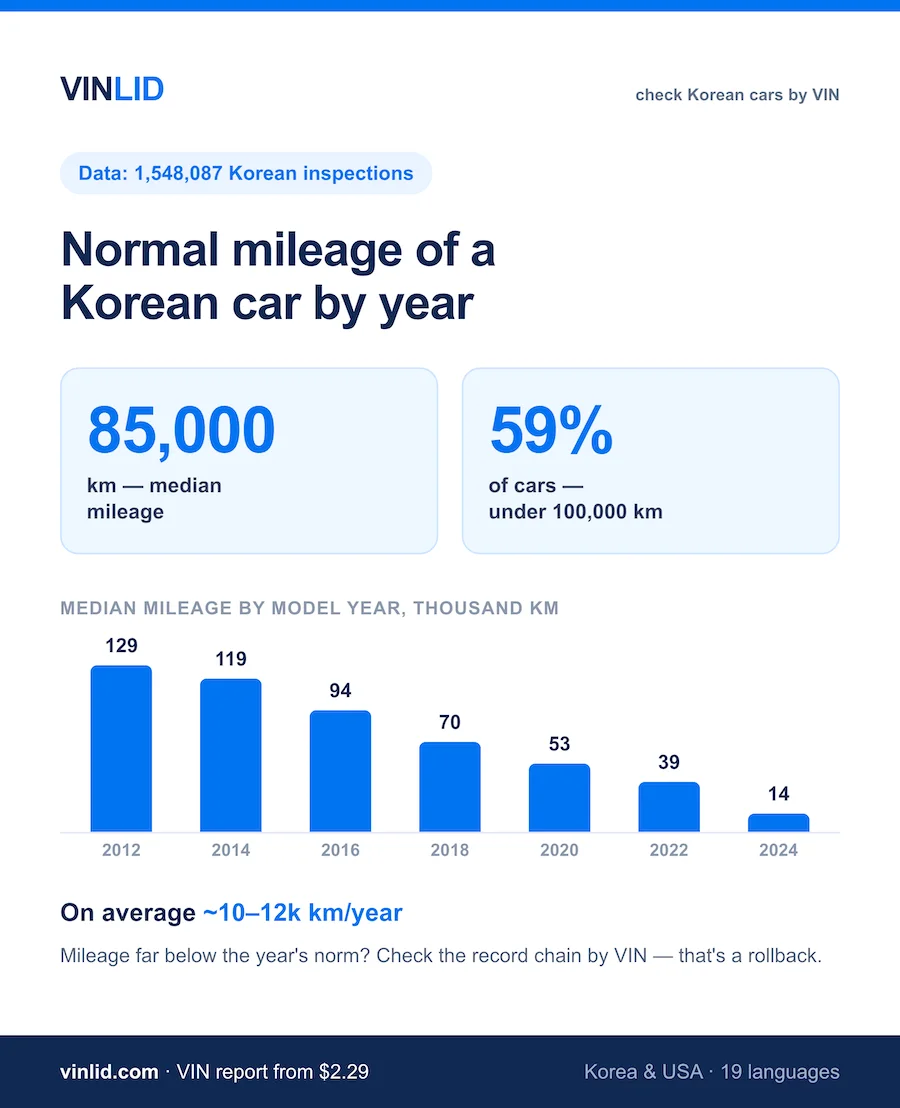
84,870 km — median mileage (half the cars are below, half above).
59% of cars — under 100,000 km.
~8% — over 200,000 km.
The average is higher than the median — 103,000 km — because a small share of high-mileage taxis and commercial cars pulls the average up. To judge what's normal, the median is the right number.
How mileage is distributed
under 50,000 km — 28% of cars
50–100k — 31%
100–150k — 22%
150–200k — 11%
200–250k — 4%
250–300k — 1.5%
over 300k — 2%
So more than half of Korean cars are low-mileage, and only about 8% are "tired" cars over 200,000 km.
Normal mileage by model year
This is the median — the typical mileage of a car of that year on the export market. Keep it as a cheat sheet:
2011 — ~139,000 km
2012 — ~129,000 km
2013 — ~125,000 km
2014 — ~119,000 km
2015 — ~109,000 km
2016 — ~94,000 km
2017 — ~82,000 km
2018 — ~70,000 km
2019 — ~60,000 km
2020 — ~53,000 km
2021 — ~47,000 km
2022 — ~39,000 km
2023 — ~25,000 km
2024 — ~14,000 km
Converted to yearly mileage, that's roughly 10,000–12,000 km a year — and it's fairly steady year to year. Koreans drive modestly.
How to catch a rollback with this
The rule is simple: compare the listing's mileage with the median for the model year.
Example. A 2019 car has a median of about 60,000 km. If the listing shows 25,000 — that's the level of a 2023 car. For a 2019, that's suspiciously low.
Caveat: low mileage can be genuine (the car really was driven little). So check not the number on the dashboard odometer, but the full chain of inspection records by VIN. Korea records the mileage at every inspection — if a later record is lower than an earlier one, that's no longer "worth a second look," it's a proven rollback.
Mileage by brand
Median mileage differs by brand too, but with an important caveat: the figure depends heavily on the age of that brand's fleet, not on "some are driven more." Brands newer to the market (Genesis, Mini) show lower mileage simply because the cars are younger.
Mini — ~59,000 km
Mercedes-Benz — ~66,000 km
Genesis — ~76,000 km
Chevrolet — ~79,000 km
Kia — ~80,000 km
BMW — ~82,000 km
Renault Samsung — ~95,000 km
Hyundai — ~96,000 km
Volkswagen — ~99,000 km
Daewoo — ~109,000 km
How to check your own car
The median by year is a good reference, but what decides it is the history of the specific VIN. The Korean report on vinlid.com shows the mileage at every inspection date — along that chain a rollback is proven, not guessed. Plus photos from the inspection stations, accident history and the body-panel replacement diagram.
See what a full report looks like — example report.
Before you pay, a free preview shows whether any records exist for the VIN. The full Korean report costs from $2.29 and is available in 19 languages.
Methodology
Sample — 1,548,087 used-car inspection reports of Korean vehicles from the vinlid.com database that have a mileage value. "Median" is the value below which half the cars fall. Mileage is taken at the inspection date (usually the point of preparation for export), so the figures describe the typical mileage of a car of that year on the export market, not "now." This is data on cars listed for sale and export, and it does not describe Korea's entire vehicle fleet. For methodological cleanliness the analysis is built on one homogeneous inspection dataset.
Frequently asked questions
What is normal mileage for a 2019 Korean car?
The median in our data is about 60,000 km. For 2020 it's ~53,000; for 2018 ~70,000. If the mileage is noticeably below the median for its year, that's a reason to check the VIN history for a rollback.
How many kilometers a year do Korean cars cover?
Roughly 10,000–12,000 km a year, and it's fairly steady. So you can estimate normal mileage from the model year: the car's age × ~10,000–12,000.
Is it true that Korean cars have low mileage?
On average, yes: 59% of cars on the export market have under 100,000 km, and only about 8% are over 200,000. The median is about 85,000 km.
How do I tell if the mileage has been rolled back?
Compare it with the median for the model year — mileage that's much too low is suspicious. But the definitive answer comes only from the chain of inspection records by VIN: if a later inspection shows fewer kilometers than an earlier one, it was rolled back.