
The Most Accident-Prone Korean Car Models: 1.5M Cars Ranked
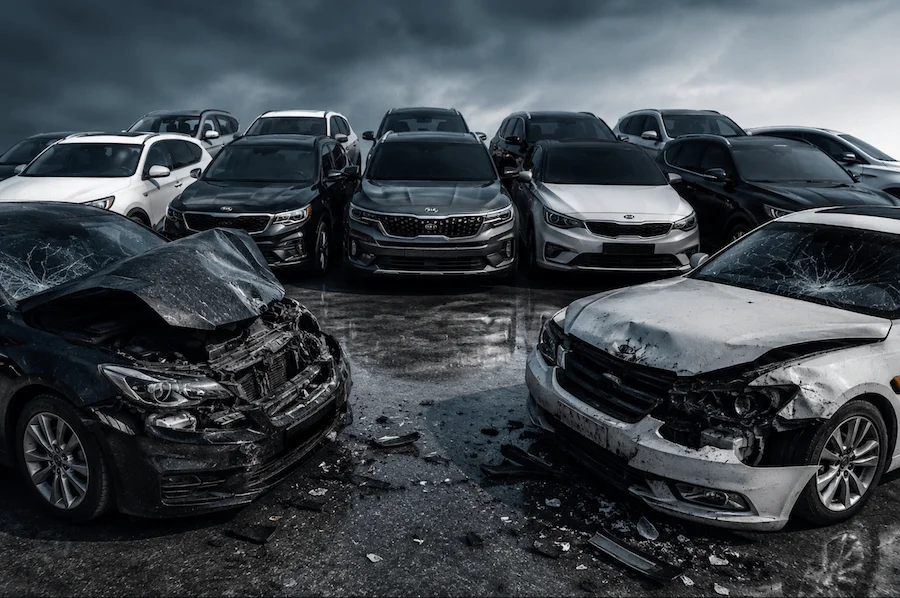
We ranked Korean cars by accident rate per model — from 4% to 26%. The most beaten are ex-taxis (Avante, Sonata, SM3) and commercial vehicles (Porter, Starex); the cleanest are new crossovers and hybrids.
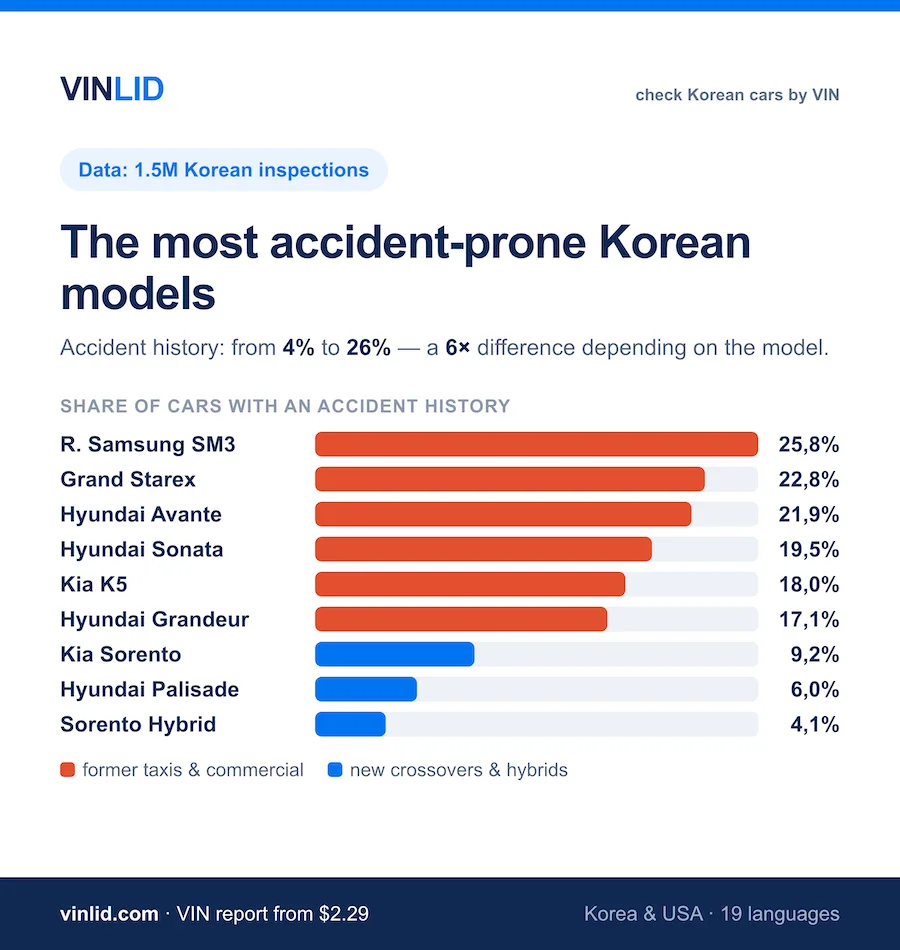
We measured the accident rate across 1,548,093 Korean inspection reports — this time not by brand, but by model. And here's the key point: the spread is huge. One model has an accident history on 4% of cars, another on 26%. A six-fold difference. So "a Korean car" isn't a verdict — the specific model decides everything.
The headline numbers
The most "beaten" mass-market model — Renault Samsung SM3 (25.8%).
The cleanest — Kia Sorento Hybrid (4.1%).
Popular family models usually sit at 10–20%.
The pattern is simple and logical: the most damaged are former taxis and commercial vehicles, and the cleanest are newer crossovers, hybrids and premium models.
The most accident-prone models
At the top are the models that in Korea worked en masse as taxis or "for business":
Renault Samsung SM3 — 25.8%
Renault Samsung SM5 — 23.4%
Hyundai Grand Starex (minivan) — 22.8%
Hyundai Avante — 21.9%
Hyundai Equus — 21.9%
Hyundai Porter II (truck) — 21.7%
Renault Samsung SM7 — 20.9%
Hyundai Sonata — 19.5%
SM3, SM5, SM7, Avante and Sonata were legendary Korean taxis. Grand Starex, Porter and Bongo are work vans and trucks. They're driven hard, often in tough conditions — hence the high share of repairs and accidents.
The cleanest models
The lowest accident rates belong to fresh crossovers, hybrids and premium models — bought "for oneself," newer, and almost never used as taxis:
Kia Sorento Hybrid — 4.1%
Genesis GV80 — 5.0%
Hyundai Palisade — 6.0%
Kia Seltos — 7.5%
SsangYong Rexton Sports — 7.5%
Hyundai Kona — 8.8%
Accident rate of popular models
And here are the figures for what actually gets imported most — keep it as a reference:
Hyundai Grand Starex — 22.8%
Hyundai Avante — 21.9%
Hyundai Sonata — 19.5%
Kia K7 — 18.4%
Kia K5 — 18.0%
Hyundai Grandeur — 17.1%
Kia Morning — 16.8%
Kia Ray — 14.3%
Hyundai Tucson — 12.0%
Kia Carnival — 11.8%
Genesis G80 — 11.1%
Kia Sportage — 11.0%
Hyundai Santa Fe — 9.9%
Kia Sorento — 9.2%
Hyundai Palisade — 6.0%
Structural (frame) damage by model
Separately, we counted the share with damage to structural (load-bearing) body members — the most serious type. Again, trucks and former taxis lead:
Hyundai Porter II — 18.9%
Hyundai Avante — 16.1%
Kia K7 — 14.8%
Hyundai Sonata — 14.6%
Kia Morning — 13.7%
Hyundai Grandeur — 12.7%
For comparison, the Kia Carnival minivan and Kia Sorento crossover had structural damage noticeably less often — around 7%.
Why some models are more beaten than others
Two factors. First — how the car was used: taxis and commercial vehicles get hit and repaired more often than private cars. Second — age: older models (Equus, the SM series) have more years and mileage behind them, while fresh crossovers and hybrids are simply younger. So this is not a "brand reliability ranking" but a picture of a specific export sample.
What this means for a buyer
The model sets the baseline risk. If you're looking at a former taxi (Sonata, Avante, SM5) or a commercial Porter/Starex — check the history especially carefully, accidents and repairs are the norm there. If it's a Palisade or a Genesis — cleaner on average, but that's no reason to skip the check: even among the "clean" models there are damaged cars, just fewer of them.
How to check a specific car
The average figure for a model is a reference, not a verdict on a specific car. What decides it is the history of that exact VIN. The Korean report on vinlid.com shows the accident history, the body-panel replacement diagram, verified mileage by inspection date, and photos from the stations. Here's a real Hyundai Avante report, for example: an example check — you can see exactly what gets verified.
Before you pay, a free preview shows whether any records exist for the VIN. The full Korean report costs from $2.29 and is available in 19 languages.
Methodology
Sample — 1,548,093 used-car inspection reports of Korean vehicles from the vinlid.com database. "Accident rate" is the share of cars with a recorded accident history. Only models with at least 5,000 records were included in the rankings, so the figures are stable. This is data on cars listed for sale and export; the accident rate is influenced by usage type (taxi, commercial) and model age, so it is not a judgement of brand reliability as such. For methodological cleanliness the analysis is built on one homogeneous inspection dataset.
Frequently asked questions
Which Korean model is the most accident-prone?
Among mass-market models — the Renault Samsung SM3 (25.8%), followed by the SM5 (23.4%) and the Hyundai Grand Starex minivan (22.8%). The reason isn't a "bad brand" but that these models worked en masse as taxis and commercial vehicles.
Which Korean model is the cleanest on accidents?
The lowest accident rate belongs to the Kia Sorento Hybrid (4.1%), Genesis GV80 (5.0%) and Hyundai Palisade (6.0%) — fresh crossovers, hybrids and premium cars that almost never end up as taxis.
How beaten are the Hyundai Sonata and Avante from Korea?
Above average: Sonata — 19.5%, Avante — 21.9%. Both were widely used as taxis, so the history of such cars is worth checking especially carefully by VIN.
Can you tell from the model whether a car is damaged?
No — the model only sets the baseline risk. Even among the "clean" models there are damaged examples. The definitive answer for a specific car comes only from checking its history by VIN.