
Korean VAT Explained: How the System Works and Where Car Buyers Get Scammed
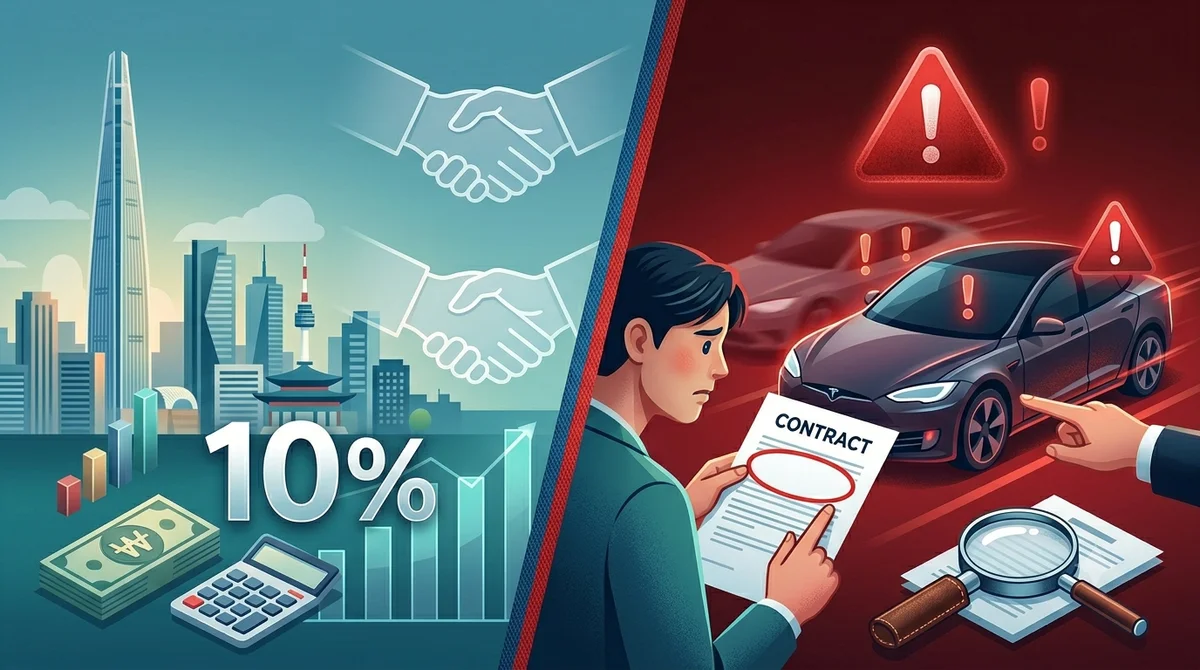
A deep dive into Korean VAT from an importer's perspective. How zero-rate exports work, what the "9.1% deemed credit" really means, why 72% of fraud comes from unregistered dealers, and how to protect yourself from 12 common scam schemes.
Why VAT Is the Most Important Topic in Korean Auto Imports
When you buy a used car from Korea, value-added tax can either save you 10% off the price — or become the loophole through which scammers extract $5,000–$25,000 from you. That's not an exaggeration. It's the average loss per victim, according to Korean law firms tracking export fraud cases.
This article lays out the complete Korean VAT scheme as it applies to used vehicles, with all the gray and black market schemes that dishonest dealers use to confuse foreigners. After reading this, you'll be able to ask dealers the right questions and immediately recognize when someone is trying to scam you.
The Basics — Three Simple Facts
South Korea has one VAT rate — 10%. The tax is called "buga-se" (short for "buga-gachi-se"). Three things to know up front:
VAT is paid by the final consumer — it's built into the price
The dealer collects VAT from the buyer and remits it to the government
Exports are zero-rated — this means foreign buyers don't pay VAT at all
That third point is the foundation of Korea's entire export economy. The government deliberately exempts exports from VAT to make Korean goods competitive abroad. The same mechanism applies to used cars leaving the country.
The Hidden Mechanism That Makes Dealers Rich
Here's information Korean dealers rarely share with foreign buyers. Korean VAT law contains a unique rule for used vehicles — a "deemed input VAT credit" at a rate of 9.1% (calculated as 9/110).
What this means in practice:
When a dealer buys a car from a private individual (which happens in 80% of cases), the seller doesn't issue a tax invoice because they aren't a business
Under normal logic, the dealer would lose the 10% input VAT
But Korean law allows the dealer to credit a deemed 9.1% of the purchase price — as if they had bought the car from a VAT payer
When the dealer resells the car, they add the full 10% VAT to the price for a domestic buyer
The difference (10% – 9.1% = 0.9%) is the actual VAT the dealer pays to the budget
Why this matters for you: the dealer has already received the 9.1% credit at purchase. When they sell the car to you at the zero rate for export, they don't need to "refund" you any 10%. Any demand to "pay extra VAT so I can issue documents" is just pocketing your money.
In December 2025, a bill was introduced in the Korean parliament to extend this credit to scrap vehicles exported for recycling — further confirming that the government actively promotes the export scheme rather than restricting it.
How a Dealer Actually Earns on an Export Sale
To understand where honest business ends and fraud begins, let's break down the revenue model of a normal export broker.
Example: Hyundai Sonata 2022:
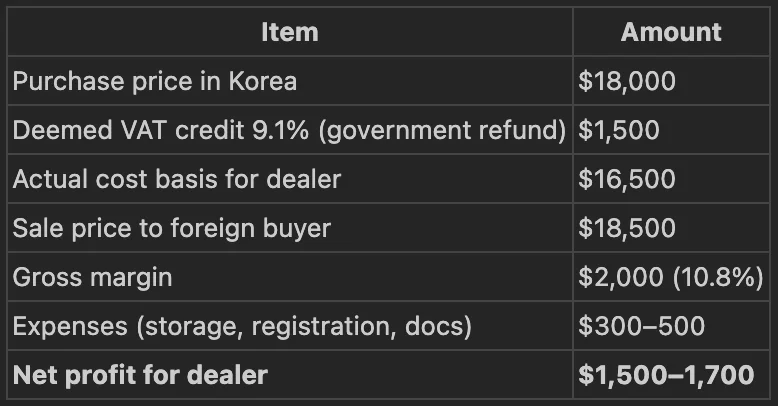
That's normal economics. If the dealer also forces you to pay 10% "VAT" on top — that's double income on a single sale: $1,500 of legitimate margin + $1,850 of stolen "VAT" = $3,350 from one car.
12 Common VAT Scam Schemes
Now the most useful part — a detailed breakdown of each scheme, so you can spot them instantly.
Scheme 1: "Price excludes VAT" — the classic
A car listed on Encar at $18,500. When it's time to pay, the dealer says: "That's the price excluding VAT, add 10%." For export, this is illegal — zero rate is mandatory. The dealer is just exploiting your ignorance.
Scheme 2: "You'll get the VAT back later"
"Pay the full 110% now, and Korean tax authorities will refund 10% after the car leaves the port." A VAT refund to a foreign buyer of a used car physically does not exist — no such mechanism exists at any customs office.
Scheme 3: Double pricing
The contract shows two amounts: "official price for documents" (low) and "actual price" (full). The dealer declares the lower amount to the government to reduce taxes but charges you the full amount. If Korean tax authorities investigate later, you as the buyer can be held liable.
Scheme 4: "VAT processing fee"
The final invoice includes a "VAT administrative fee" of $200–500. No government fee for "processing VAT" exists — it's a dealer invention.
Scheme 5: Switching taxpayer status
The dealer shows you a general taxpayer registration but books the deal through an affiliated simplified-taxpayer company. The documents you receive offer no legal protection. Always cross-check the business license number on the final invoice.
Scheme 6: "Export registration tax"
The dealer adds an "obligatory export registration fee" of $300–800. The real cost of export registration in Korea is $15–40. The difference goes into the dealer's pocket.
Scheme 7: Inflated port fees
"Port charges and customs processing" balloon to $1,500–3,000. The real cost per car is $250–500. Always request copies of port receipts.
Scheme 8: Fake export declaration
The dealer gives you a copy of the export declaration with one set of numbers, but submits different data to tax authorities. Customs in your destination country may detain the car when figures don't match. Demand the original declaration with the Korea Customs Service stamp.
Scheme 9: "Deposit to prepare VAT documents"
"Send 100% payment, and we'll prepare your export package." After receiving the money, the dealer disappears. According to Korean lawyers, this scheme results in average losses of $5,000–25,000 per victim.
Scheme 10: "VAT-free export" — fictitious export
The dealer registers the car as an export (to get the zero rate and credit) but actually sells it domestically through a proxy buyer. You have the paperwork, but the car never reaches you.
Scheme 11: Tax invoice from a "dead" company
The dealer issues an invoice from a company that closes within a month. If problems arise, there's no one to file a claim against. This is one of the hardest schemes to detect.
Scheme 12: Currency rate manipulation
The price is fixed in dollars, but "due to exchange rate changes," the final won amount ends up 3–7% higher. If you don't track the rate on payment day, the dealer pockets the difference.
How to Verify a Dealer in 10 Minutes
Korean authorities maintain public registries that are free to use from anywhere in the world. Here's a step-by-step check for any exporter.
Step 1: Business license check
Every legal dealer has a 10-digit business registration number. Enter it on the Korean tax service website (hometax.go.kr, available in English) — the system shows:
Whether the registration is currently active
Taxpayer status (general or simplified)
Date the business was founded
If the company was registered less than 6 months ago, that's a serious red flag for any large transaction.
Step 2: KAIDA membership
KAIDA is the Korean Association of Independent Dealers and Exporters. As of 2025, about 2,800 exporters are registered. If your dealer isn't in the registry, they operate outside the association — and your legal protection in case of dispute will be minimal.
Step 3: Search for company in news and reviews
Search the company name on Korean forums like Naver Cafe and in Facebook groups like "Every Expat in Korea". If there's no mention of the company in the past year, that's a reason to pause.
Step 4: Address check via map
Ask the dealer for their legal address and verify it on Naver Map. If the address turns out to be a residential apartment or an empty plot — you're dealing with a shell company.
Safe Payment Scheme — the Only Reliable Path
The single most important rule that prevents 90% of scams: never pay 100% upfront. A safe payment scheme looks like this:
Deposit of 10–30% via bank wire to the company's business account (no WhatsApp numbers, no personal cards)
Balance payment only after B/L (Bill of Lading) — the document confirming that the car is physically loaded onto the ship
Additional safeguard — a photo of the VIN from the ship or container
If the dealer refuses this structure and insists on full prepayment — automatically pass on the deal. Real exporters with reputation accept these terms as standard.
Korean Customs Reporting — Your Hidden Shield
A little-known protection mechanism is that Korea Customs Service is required to log every vehicle entering a bonded warehouse before loading. The purpose is to prevent stolen cars from being exported.
For you, this means:
Every legally exported vehicle has an official record in the customs database
That record contains the VIN, intake date, and exporter name
You can ask the dealer for this record number and verify it
If the dealer can't provide this number — the car either hasn't been registered for export (meaning you're paying for nothing), or the scheme is gray.
Real Cost Breakdown — What a Car Should Actually Cost
To compare offers, here's a transparent formula of price for an export buyer.
Hyundai Tucson 2021, mid-tier trim:
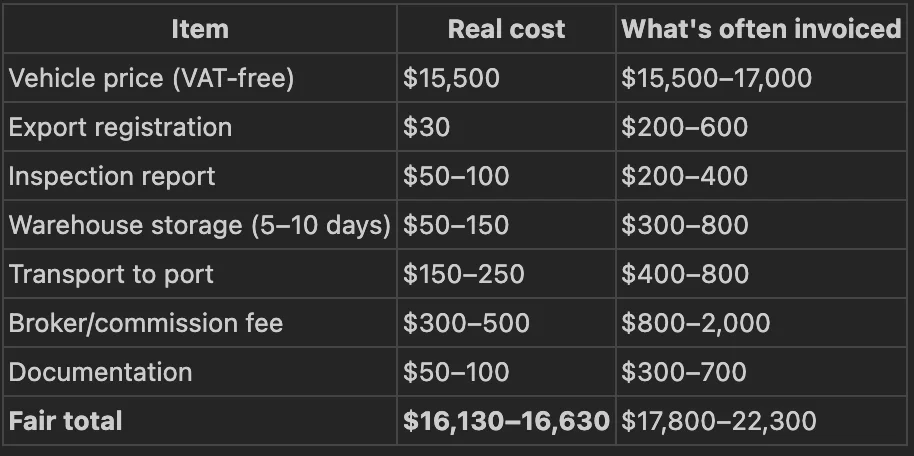
If the dealer's quote falls into the right column, an extra $1,500–5,000 is built in via fictitious fees and fake VAT charges.
Documents You Must Receive
After the deal closes, you must have seven documents in hand:
Sales contract — signed by both parties
Export tax invoice — official document with the dealer's stamp
Export Declaration Certificate — stamped by Korea Customs Service
Vehicle registration card — original, not a copy
Bill of Lading (B/L) — from the carrier
Technical inspection report
Photo log — VIN, odometer, body before loading
Missing any of these documents creates automatic problems at customs clearance in your country. Without the export declaration, for example, even Korean customs won't release the car.
A Critical Side Note — Mileage Fraud
Korean VAT isn't the only fraud scheme. According to one investigation, more than 20% of Korean cars exported to Nigeria in 2023 showed signs of odometer rollback. Most of these cars went through unregistered exporters or informal channels.
The connection to VAT fraud is direct: a dealer willing to cheat you on taxes is just as willing to cheat you on mileage. So checking the VIN history through an independent service isn't an optional extra — it's a mandatory part of the deal. A $2–10 report is nothing compared to the $5,000–25,000 loss from buying a blind car.
What to Do If You've Been Scammed
If you realize you've fallen into a scam, act fast:
Within 24 hours — collect all correspondence, contracts, and bank receipts
File a complaint with Korea Customs Service through customs.go.kr — they have a dedicated export fraud division
Contact KAIDA — if the dealer was a member, there's a chance of recovery via the association's guarantee fund
File a report with the Cyber Bureau of Korean National Police Agency
Auto dealer fraud lawyers in Korea work with foreign clients on a contingency basis — no upfront payment required
The recovery process typically takes 6–18 months and succeeds in about 30–40% of cases when the scammer is a registered business. With shell companies, the chance of recovery is near zero.
Key Takeaways
The Korean VAT system is designed in favor of the export buyer — the zero rate and the deemed-input-credit mechanism make exports profitable for both the dealer and the foreign buyer. Problems don't come from the system itself — they come from dishonest dealers using the complexity of the rules to confuse foreigners.
Remember four golden rules:
Never pay VAT on top of a quoted export price. It's always a scam.
Never pay more than 30% as a deposit until the car is loaded onto a ship.
Always verify the dealer through the tax service database and the KAIDA registry — it's free and takes 10 minutes.
Always check the car's history via VIN — mileage fraud often comes paired with tax fraud.
The $1,500–2,500 you save by understanding VAT correctly, plus the protection from $5,000–25,000 in fraud risk — that's the reason to spend half an hour studying these rules before buying a car from Korea.
And remember: a dealer who answers all your VAT questions confidently and shows documents without resistance is a dealer you can work with. Anyone who dodges questions or pressures you for urgency should be off your list before any payment is made.