
Diesel, Petrol or Hybrid: What Fuel Used Korean Cars Run On
We broke down 1.5M Korean cars by fuel type. Petrol 47%, diesel 40%, LPG 5%, hybrid 5%, electric 2%. What it means for a buyer.
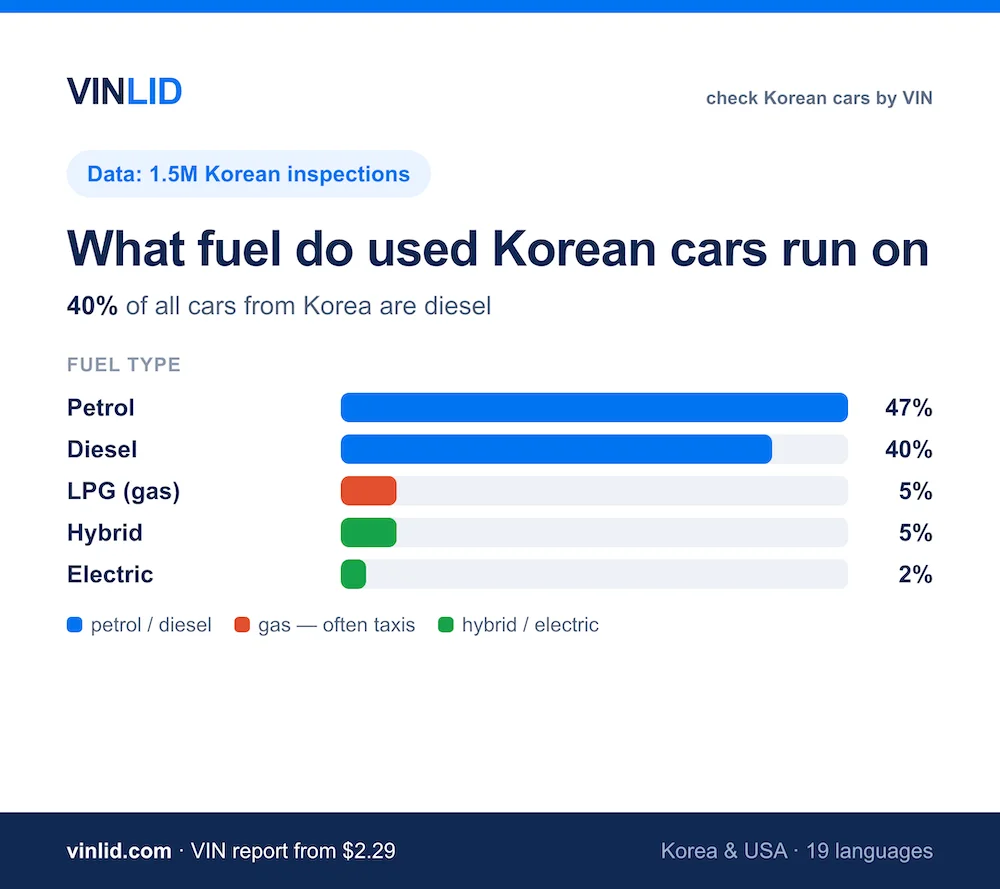
We broke down 1,548,093 Korean cars by fuel type. The surprise for many: 40% of all cars from Korea are diesel — literally two in five. Another 47% are petrol, and the remaining ~13% is split between LPG, hybrids and electric. If you assumed "Korea mostly exports petrol cars," that's not quite right.
The headline numbers
Petrol — 47%
Diesel — 40%
LPG (gas) — 5%
Hybrid — 5%
Electric — 2%
Hydrogen — 0.1%
Electrified cars together (hybrid + electric + hydrogen) already make up about 7% — and the share is growing.
There's more diesel than you'd think
40% is a lot. In Korea, diesel was fitted widely to crossovers, minivans and commercial vehicles. For a buyer this matters for several reasons:
Import duties and taxes. In many countries diesel is taxed differently — check the rates for the specific fuel type and engine size.
Durability and upkeep. A high-mileage diesel means the DPF, injectors and high-pressure pump. Check the real mileage and the repair history.
Emissions rules. Some cities restrict older diesels — check the local regulations.
LPG (gas) is often a former taxi
5% of Korean cars run on LPG. In Korea, LPG was traditionally the fuel of taxis and part of the commercial fleet. This lines up with our earlier study: former taxis (Sonata, Avante, the SM series) have above-average accident rates. So if you're looking at a Korean LPG sedan, check its history especially carefully — there's a good chance it's a former taxi with high mileage.
Electrics and hybrids are gaining share
Hybrids (5%), electric cars (2%) and even hydrogen cars (0.1%, mostly the Hyundai Nexo) add up to about 7%. The share is still small, but it's noticeably higher for recent model years — Korea is one of the world's EV leaders, and the Ioniq, EV6 and Kona Electric are increasingly exported. Plus, per our accident data, hybrids and electric crossovers are the "cleanest" segment: they're bought for personal use and almost never run as taxis.
What this means for a buyer
Don't assume "Korean = petrol." There's a 40% chance it's diesel — confirm the fuel type before paying a deposit.
LPG is a taxi red flag. Check the mileage and accident history of such a car.
Hybrid/electric is the calmest segment on accidents, but you still need to check the battery and its condition separately.
How to check a specific car
The fuel type, real mileage, accident history and body-panel replacement diagram are all visible by VIN. The Korean report on vinlid.com brings this together in one place — plus photos from the inspection stations. Here's an example VIN report.
Before you pay, a free preview shows whether any records exist for the VIN. The full Korean report costs from $2.29 and is available in 19 languages.
Methodology
Sample — 1,548,093 used-car inspection reports of Korean vehicles from the vinlid.com database. The fuel type is taken from the inspection data. This is data on cars listed for sale and export, and it does not describe Korea's entire vehicle fleet. For methodological cleanliness the analysis is built on one homogeneous inspection dataset.
Frequently asked questions
What percentage of Korean cars are diesel?
In our data — 40%. Another 47% are petrol, 5% run on LPG, 5% are hybrids and 2% are electric. So diesel is roughly two in five cars from Korea.
Are there many electric cars and hybrids from Korea?
Together with hydrogen — about 7%, and the share is higher for recent years. Korea actively exports the Ioniq, EV6, Kona Electric and Hyundai/Kia hybrids.
Why should Korean LPG cars be checked more carefully?
Because in Korea LPG was widely used by taxis. An LPG sedan is quite likely a former taxi with high mileage and an accident history, so a VIN check is especially important here.
How do I find out the fuel type before buying?
It's in the inspection report by VIN, along with the real mileage and repair history. Don't rely on the seller's word alone.