
How Many Used Korean Cars Are "Accident" Cars: 1.5M Inspection Reports Analyzed
1.5M Korean inspection reports analyzed: 14.4% of cars have an accident history, but 39.7% had a body panel replaced. Why "accident-free" doesn't mean "no bodywork."
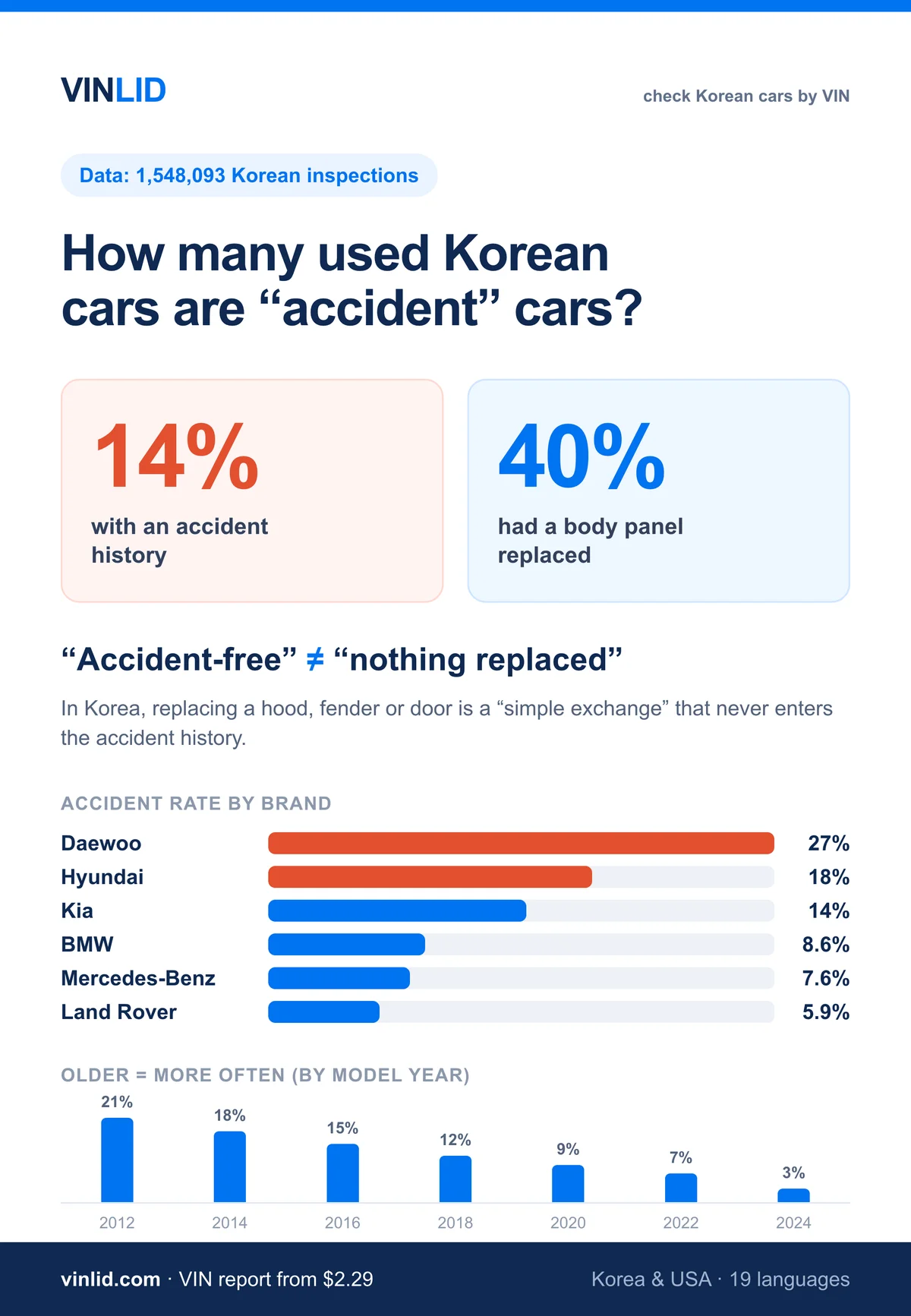
Vinlid analyzed 1,548,093 used-car inspection reports from South Korea. In short: 14.4% of cars have an accident history, almost 11% have structural-frame damage, and 39.7% have had at least one body panel replaced — nearly four cars in ten. The gap between those numbers is the single most important thing for anyone buying a Korean car to understand.
The headline numbers
14.4% — with a recorded accident history.
10.75% — with damage to structural (load-bearing) body members.
39.7% — with at least one replaced body panel.
At first glance this looks like a contradiction: only 14% are "accident" cars, yet 40% had panels replaced. There's no contradiction — and this is the whole trick of the Korean market.
Why "accident-free" ≠ "nothing was replaced"
Korea's inspection splits panel replacement into two classes. Bolt-on panels — hood, fender, door, trunk lid, radiator support — count as a "simple exchange" and do not go into the accident history. An accident is only recorded for repair or replacement of welded structural members — pillars, floor, rails, and the quarter panel, side sill and roof when they are cut, welded or replaced.
The takeaway for a buyer: a car with a replaced fender and hood is legally sold in Korea as "accident-free." Technically that's true. In reality, bodywork was done. That's exactly why a single "accident: yes/no" flag isn't enough — you need to see which specific panels were touched.
Which panels are replaced most often
The distribution in our data mirrors this logic exactly. The bolt-on panels that do NOT go into the accident history are replaced far more often than structural ones:
Front fender — 379,543 replacements (bolt-on, replacement not counted as accident) — the #1 part
Door — 249,110 (bolt-on, not an accident)
Hood — 178,207 (bolt-on, not an accident)
Quarter panel — 149,331 (welded panel — replacement goes into accident history)
Radiator support — 129,485 (bolt-on part, replacement not counted as accident)
Trunk lid — 107,629 (bolt-on, not an accident)
Side sill — 33,957 (welded — replacement goes into accident history)
Roof — 11,469 (welded — replacement goes into accident history)
Front fender is part #1 — no surprise, since most impacts land on the front corner. Note that five of the eight most-replaced parts are bolt-on panels (fender, door, hood, radiator support, trunk lid), which under the Korean standard never enter the accident history. That's precisely why cars have had far more bodywork than they have formal "accidents."
Accident rate by brand
The share of cars with an accident history varies noticeably by brand (the number checked is in brackets). Important caveat: this is a statistic on the export pool — the figures are shaped by fleet age and model volume, and are not a judgement of brand reliability as such.
Daewoo — 27.3% (18,019)
Renault Samsung — 18.7% (71,135)
Hyundai — 17.6% (461,122)
Chevrolet — 15.1% (74,578)
Kia — 14.0% (435,437)
SsangYong — 13.7% (58,896)
Genesis — 12.7% (63,187)
Volkswagen — 10.4% (20,065)
Audi — 9.9% (32,747)
Ford — 9.0% (10,532)
Porsche — 8.8% (9,611)
BMW — 8.6% (82,714)
Mercedes-Benz — 7.6% (89,574)
Mini — 6.5% (14,560)
Land Rover — 5.9% (14,010)
Accident rate by model year
Here the pattern is simple and expected: the older the car, the higher the chance of an accident history — simply because it has spent more years on the road.
2012 — 21.4%
2014 — 17.9%
2016 — 14.7%
2018 — 11.7%
2020 — 9.4%
2022 — 7.3%
2024 — 3.3%
How to check this for a specific car
General statistics are useful, but a buyer needs an answer for their own VIN. The Korean report on vinlid.com shows not just an "accident: yes/no" flag but a body diagram marking which panels were replaced or repaired — bolt-on and structural separately. Plus verified mileage, photos from the inspection stations, and a condition assessment across roughly 69 items.
Before you pay, a free preview shows whether any records exist for the VIN. The full Korean report costs from $2.29 and is available in 19 languages.
Methodology
Sample — 1,548,093 used-car inspection reports of Korean vehicles from the vinlid.com database. "Accident history" is the inspection site's flag. "Structural damage" is repair or replacement of welded frame members. "Body panel replaced" is at least one bolt-on or structural panel in the repair record. This is data on cars listed for sale and export, and it does not describe Korea's entire vehicle fleet. The vinlid.com database holds over 3.2M records from various Korean sources; for methodological cleanliness this analysis is built on one homogeneous inspection dataset. The panel classification (bolt-on "simple exchange" vs structural "accident") follows the official inspection form defined by South Korean law.
Frequently asked questions
What percentage of used Korean cars are accident cars?
Across 1.5M inspection reports, 14.4% have an accident history. But 39.7% have had at least one body panel replaced — because replacing bolt-on panels (hood, fender, door, trunk lid) is not counted as an accident in Korea.
What does "accident-free" mean on a Korean car?
It means "no structural-frame damage" — not "no repairs." The hood, fender, door, trunk lid or radiator support may have been replaced: that's a "simple exchange," and it doesn't cancel the "accident-free" status. So "accident-free" ≠ "no bodywork or insurance claims." That's why you should look not only at the flag but at the panel-by-panel diagram for the VIN.
Which Korean brand has the fewest accident cars?
In our export sample the lowest accident share is for Land Rover (5.9%), Mini (6.5%) and Mercedes-Benz (7.6%); the highest is for Daewoo (27.3%), Renault Samsung (18.7%) and Hyundai (17.6%). This reflects the age and structure of the export fleet, not brand reliability directly.
Which panel is replaced most often on Korean cars?
The front fender is the most frequently replaced panel in the sample (379,543 cases), followed by the door and hood. All three are bolt-on panels that do not enter the accident history.